
Area 51: Nevada’s Secret Aerospace Hub, What You Need To Know
Explore the real story behind Area 51, from Cold War spy planes to modern mysteries in the Nevada desert.
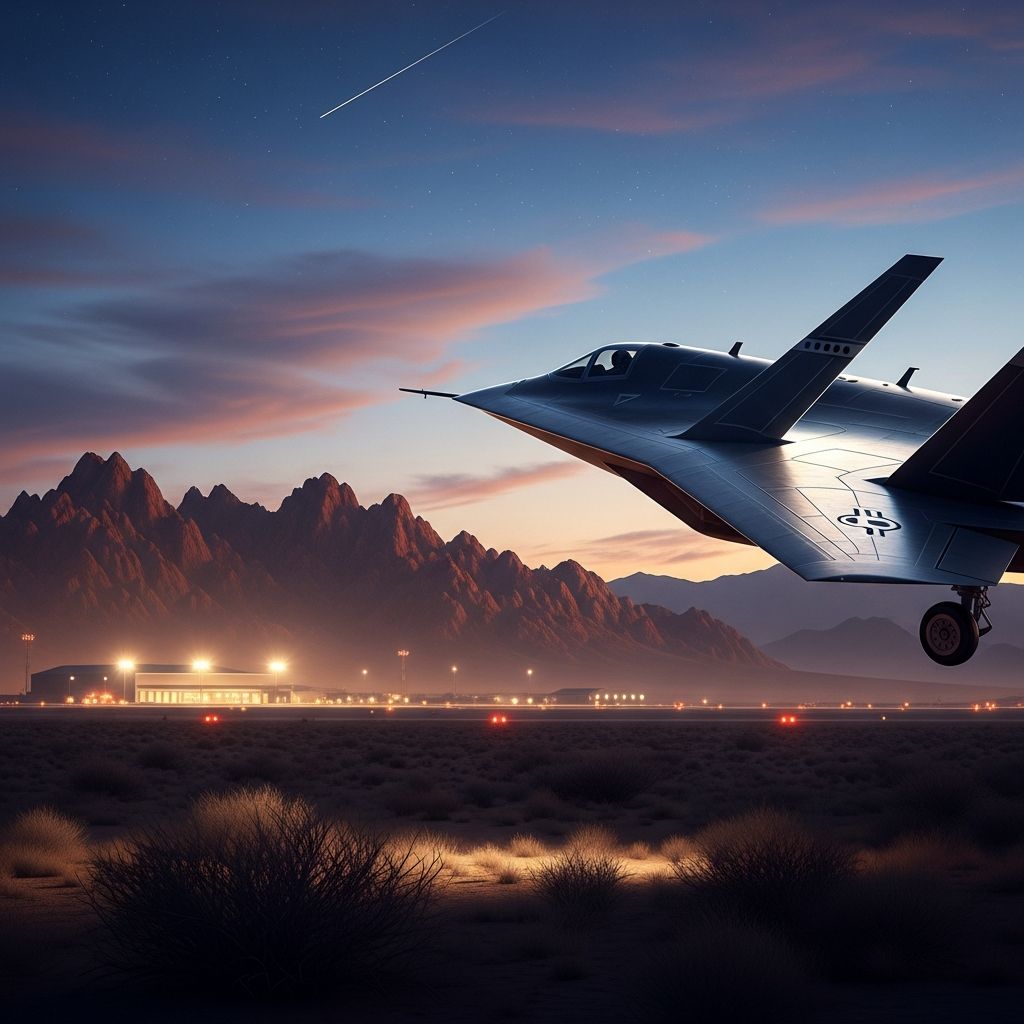
Deep in the arid expanse of the Nevada desert, a site shrouded in mystery has captivated imaginations for decades. Formally known as Groom Lake or Homey Airport, Area 51 serves as a pivotal testing ground for cutting-edge military aviation technology. Established during the height of the Cold War, this restricted zone has been the birthplace of spy planes and stealth aircraft that reshaped global reconnaissance capabilities.
The Origins in a Remote Desert Salt Flat
In 1955, the Central Intelligence Agency (CIA) faced a pressing need for a secluded location to develop and test the Lockheed U-2 spy plane. This high-altitude reconnaissance aircraft was designed to soar above Soviet defenses, capturing vital intelligence during an era of escalating tensions. Officials scoured maps for a spot offering isolation, reliable weather, and proximity to air routes. Groom Lake, a dry salt flat on the edge of the Atomic Energy Commission’s Nevada Proving Ground, emerged as ideal.
The site’s selection was pragmatic. Its remoteness—about 85 miles northwest of Las Vegas—minimized public exposure, while the surrounding terrain provided natural camouflage. The CIA funneled funds through the Atomic Energy Commission to maintain secrecy, designating the area by its map coordinate: Area 51. Construction began swiftly, transforming the barren lake bed into a functional airfield with hangars and support facilities.
- Key factors in site selection: Remote location, clear skies year-round, and existing government land control.
- Funding mechanism: CIA check for $1.25 million to Lockheed’s Kelly Johnson, masked under Atomic Energy Commission auspices.
- Initial purpose: Exclusive testing of U-2 prototypes without interference from commercial or civilian flights.
Birth of the U-2: Peering Over Enemy Lines
The U-2 program marked Area 51’s debut as an innovation hub. This single-engine jet could reach 70,000 feet, far beyond the reach of most interceptors, enabling photographers to capture detailed images of Soviet military installations, missile sites, and nuclear facilities. Pilots underwent rigorous training at the base, adapting to the aircraft’s demanding flight profile that required precise control near the edge of space.
Declassified documents reveal the program’s intensity. Test flights pushed the U-2 to its limits, refining engines, cameras, and survival gear for pilots exposed to extreme altitudes. The aircraft’s success provided the U.S. with unprecedented insights into adversary capabilities, influencing strategies throughout the Cold War. By the late 1950s, U-2 missions overflew China, the Soviet Union, and other hotspots, often with allied support to obscure American involvement.
| Aircraft | Altitude Capability | Primary Role | Testing Era at Area 51 |
|---|---|---|---|
| U-2 | 70,000 feet | High-altitude reconnaissance | 1955–1960s |
| A-12 (Oxcart) | 90,000+ feet | Mach 3+ spy plane | 1960s |
| F-117 Nighthawk | Variable | Stealth attack | 1970s–1980s |
Evolution to Advanced Projects: From Oxcart to Stealth
Area 51’s role expanded beyond the U-2. The A-12 Oxcart project introduced the first Mach 3+ spy plane, capable of sustained speeds three times the speed of sound over 3,000 miles without refueling. This titanium-skinned marvel tested ramjet engines and nuclear rocket concepts in the base’s expansive ranges.
By the 1970s and 1980s, the facility pioneered stealth technology. The F-117 Nighthawk, the world’s first operational stealth fighter, underwent crucial flight tests here. Its angular design deflected radar waves, revolutionizing aerial combat. Aerospace historian Peter Merlin notes in his comprehensive study that Area 51 hosted over 70 years of such classified developments, from drones to hypersonic vehicles, many still undisclosed.
Nuclear-related experiments also featured prominently. Early plans envisioned small-scale atomic tests to advance thermonuclear weapons, though larger atmospheric detonations dominated Nevada’s broader test sites. Facilities for nuclear rockets persisted into the 1970s, underscoring the base’s multifaceted mission.
Government Denial and the 2013 Revelation
For nearly six decades, the U.S. government denied Area 51’s existence. Official maps omitted it, and inquiries met with silence or misdirection. This veil fueled public suspicion, especially after U-2 incidents like the 1960 Francis Gary Powers shoot-down over the Soviet Union, which pilots sometimes attributed to weather research to protect secrets.
A turning point came in 2013. Responding to a 2005 Freedom of Information Act request, the CIA declassified documents detailing the U-2 and A-12 programs. These papers explicitly named Area 51 as Groom Lake, part of the 368,000-acre Nevada Test and Training Range. That December, President Barack Obama referenced it publicly during the Kennedy Center Honors, marking official acknowledgment.
“Area 51 does not exist under that specific designation, as it’s formally known as Groom Lake and Homey Airport.”
Modern Operations and Restricted Access
Today, Area 51 remains active within a vast military complex. Heavily guarded perimeters, motion sensors, and armed patrols enforce no-fly and no-trespass zones. Employees commute via unmarked flights from Las Vegas, sworn to secrecy. The base supports ongoing tests of advanced aircraft, drones, and electronic warfare systems, though specifics elude public knowledge.
Part of the larger Nevada National Security Site legacy, it integrates with nuclear test history while focusing on aviation. Recent satellite imagery shows expanded runways and hangars, hinting at next-generation projects.
Why Area 51 Sparks Alien Conspiracy Theories
Secrecy breeds speculation. High-altitude U-2 flights in the 1950s often appeared as bright lights to ground observers, sparking UFO reports. The government’s non-denial policy amplified myths of extraterrestrial craft and reverse-engineered technology. Books like Annie Jacobsen’s Area 51: An Uncensored History explore these narratives, blending fact with unverified claims.
Despite declassifications, no credible evidence links Area 51 to aliens. Historians like Peter Merlin emphasize its terrestrial focus: spy planes, stealth, and defense tech. Occasional UAP (Unidentified Aerial Phenomena) reports persist, but official probes, such as those by the Pentagon, find mundane explanations or classified human tech.
- Common myths: Alien autopsies, Roswell crash debris, government cover-ups.
- Real drivers: Test flights mistaken for UFOs, strict NDAs fostering distrust.
- Expert view: “This isn’t a book about UFOs or conspiracy theories, but the REAL Area 51.”
Visiting the Periphery: Extraterrestrial Highway Adventures
While the base is off-limits, enthusiasts flock to nearby vantage points. State Highway 375, dubbed the Extraterrestrial Highway, offers distant views of restricted airspace. The Little A’Le’Inn in Rachel, Nevada, serves as a hub for alien-themed lodging, burgers, and memorabilia. Annual events like the Storm Area 51 festival (2019) drew crowds, though access remains prohibited.
Tips for desert explorers:
- Respect warning signs and boundaries to avoid fines or detention.
- Visit Tikaboo Peak for legal viewpoints with binoculars.
- Combine with Las Vegas trips for a mix of neon and mystery.
Area 51’s Lasting Impact on Aviation and Security
Area 51’s innovations have profoundly shaped modern air power. U-2 derivatives still fly surveillance missions, F-117 tech informs all stealth aircraft, and ongoing work ensures U.S. aerial superiority. Its story illustrates the balance between secrecy and national security in a transparent age.
As declassifications continue, more chapters may emerge, but core operations stay veiled. This Nevada enclave endures as a testament to human ingenuity amid the stars—or perhaps just very fast planes.
Frequently Asked Questions (FAQs)
What is Area 51 really used for?
Primarily aircraft testing, including spy planes and stealth technology.
Can you visit Area 51?
No, it’s a restricted military zone, but nearby roads offer distant sights.
Did the government admit Area 51 exists?
Yes, in 2013 via CIA declassified documents.
Are there aliens at Area 51?
No verified evidence; myths stem from secret tests.
How do you get to the Area 51 area?
Drive NV-375 from Alamo, Nevada, but stay on public roads.
References
- The Secret History of Area 51 — HistoryFacts.com. 2023. https://historyfacts.com/us-history/article/what-is-area-51-secret-history/
- Unlocking the Mysteries of Area 51 — SPYSCAPE. 2023. https://spyscape.com/article/unlocking-the-mysteries-of-area-51
- The Secret History of Area 51 with Peter Merlin — YouTube (War Stories with Matt Anderson). 2024. https://www.youtube.com/watch?v=V6gJ0SQQTFA
- The Secret History of the U-2 – and Area 51 — National Security Archive, George Washington University. 2013-08-15. https://nsarchive2.gwu.edu/NSAEBB/NSAEBB434/
- Area 51: An Uncensored History of America’s Top Secret Military Base — Wikipedia (book summary). N/A. https://en.wikipedia.org/wiki/Area_51:_An_Uncensored_History_of_America’s_Top_Secret_Military_Base
- Dreamland: The Secret History of Area 51 — Air Force Museum Foundation (book by Peter W. Merlin). 2024. https://shop.airforcemuseumfoundation.org/products/dreamland
Similar Articles








Read full bio of medha deb