
Market Street Car-Free Changes: 7 Loading Bays Pilot In 2025
Discover how San Francisco transformed its bustling Market Street into a car-free haven, boosting safety and transit, amid recent policy shifts.
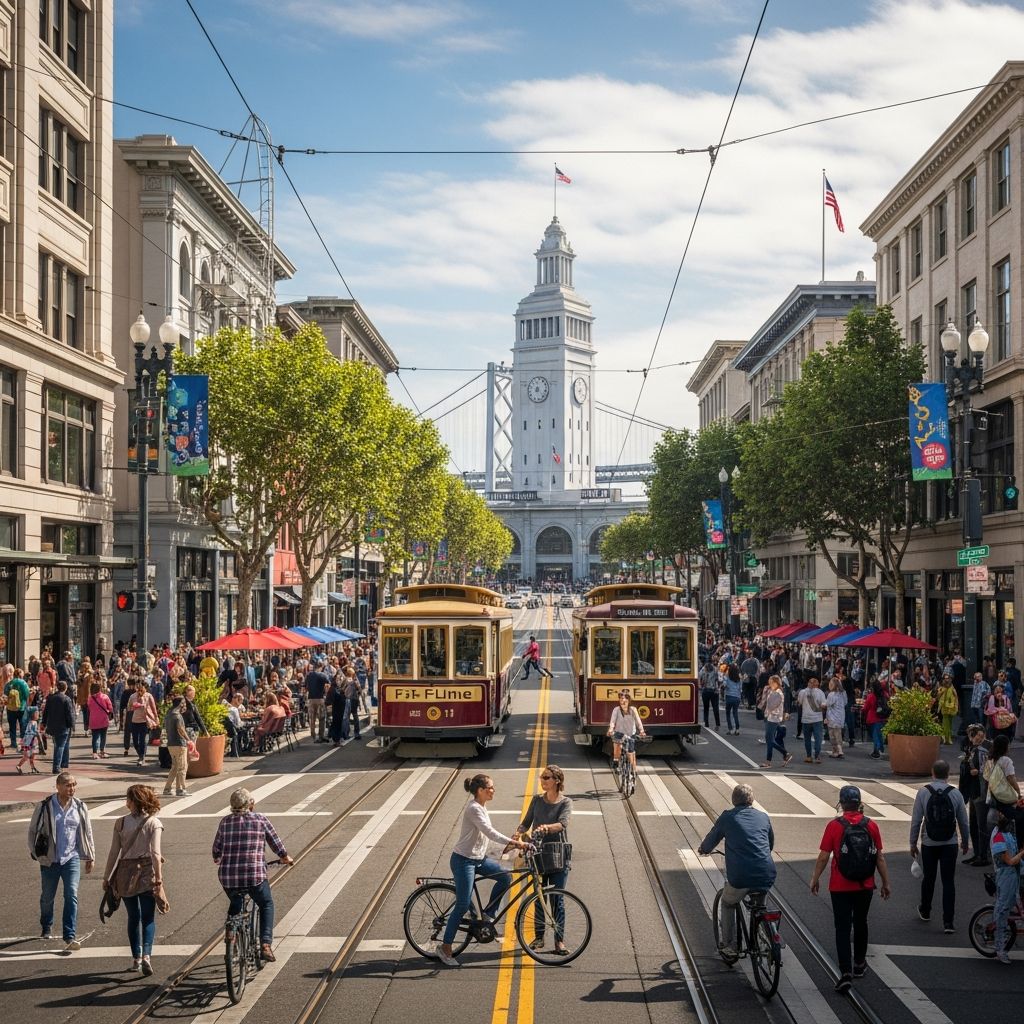
San Francisco’s iconic Market Street has undergone a remarkable transformation since early 2020, shifting from a congested vehicular thoroughfare to a vibrant, car-free corridor designed to prioritize public transit, pedestrians, and cyclists. This change, implemented by the San Francisco Municipal Transportation Agency (SFMTA), aimed to enhance safety and streamline Muni bus and light-rail services along one of the city’s busiest arteries.
The Birth of a Car-Free Vision
In late January 2020, the SFMTA launched the car-free initiative on Market Street, prohibiting private vehicles from traveling eastbound between 10th Street and Main Street, and westbound from Steuart Street to Van Ness Avenue. This targeted the most trafficked segments, where vehicles could still cross at intersections but were barred from through travel or turns into the restricted zones. Supporting adjustments extended to nearby Second Street and Steuart Street, creating a cohesive network to support the main corridor’s redesign.
The project was part of a broader “Quick Build” program, funded through voter-approved transportation taxes, involving rapid installation of signage, barriers, and pavement markings. City leaders, advocacy groups, and residents celebrated the rollout at Embarcadero Plaza, marking a pivotal step toward sustainable urban mobility.
Key Benefits Realized Over Five Years
The car-free policy delivered tangible improvements across multiple metrics. Muni services on Market Street experienced a 14% increase in speed and reliability, drastically reducing delays caused by private car interference. Pedestrian safety surged, with fewer conflicts between vehicles and people on foot or bikes, fostering a more inviting public space.
- Transit Efficiency: Faster Muni routes meant shorter wait times and higher ridership potential.
- Safety Gains: Elimination of through-traffic minimized collision risks in high-density areas.
- Vibrant Street Life: Space once dominated by cars became available for outdoor dining, events, and leisure activities.
These outcomes aligned with global trends in cities like Paris, Copenhagen, and Bogotá, where removing cars from central streets has revitalized downtowns and promoted healthier urban environments.
Implementation Details and Daily Operations
The car-free zones were clearly demarcated with red-painted areas and directional signage, unveiled on launch day. Enforcement relied on a mix of physical barriers, digital signs, and officer patrols, ensuring compliance while allowing essential services like emergency vehicles and commercial deliveries during off-peak hours.
| Direction | Restricted Segment | Exceptions |
|---|---|---|
| Eastbound | 10th St to Main St | Crossings at intersections; no turns |
| Westbound | Steuart St to Van Ness Ave | Crossings at intersections; no turns |
| Adjacent Streets | Second St (Stevenson-Market); Steuart NB (Mission-Market) | Southbound Steuart unchanged |
This structured approach balanced accessibility with restriction, maintaining connectivity for the city’s grid while prioritizing mass transit.
Recent Policy Shifts: Rideshares Return
After five years of strict car-free status, changes emerged in 2025 under Mayor Daniel Lurie’s administration. In April 2025, Waymo autonomous vehicles received approval for limited operations, followed by Uber Black and Lyft Black services starting August 26, 2025. These are confined to Market Street between Van Ness and Steuart, with pick-up/drop-off at seven designated loading bays between 5th and 8th Streets.
Operational hours vary: Waymo from 9 a.m. to 4 p.m. and 7 p.m. to 6 a.m., while Uber and Lyft Black align with evening slots. This pilot program evaluates safety, efficiency, and demand, aiming to support downtown revitalization amid post-pandemic recovery.
Controversy and Advocacy Pushback
Not all stakeholders welcomed the reversal. The Keep Market Street Moving Alliance, comprising nonprofits and businesses, condemned the decision as a betrayal of the 2019 SFMTA Board resolution to remove cars for congestion relief and sustainability. Critics argue it risks undoing progress, potentially slowing Muni again and heightening pedestrian hazards.
Walk SF and similar groups rallied in August 2025, documenting illegal driving incidents and highlighting global counterparts doubling down on car-free policies. They warn that even limited vehicles could embolden broader non-compliance.
Leading cities worldwide are expanding car-free downtowns, not reintroducing traffic—San Francisco should follow suit for a thriving future.
Economic and Social Ripples
The car-free era spurred economic vibrancy. Businesses along Market reported increased foot traffic, with widened sidewalks accommodating cafes, pop-ups, and markets. Tourism benefited from a more navigable, photogenic streetscape, drawing visitors eager for authentic San Francisco experiences.
Socially, the space became a canvas for community events, protests, and daily leisure, embodying the city’s progressive ethos. However, downtown’s struggles—office vacancies and retail slumps—prompted the rideshare pilot as a bid to boost accessibility and patronage.
Global Context: Lessons from Car-Free Pioneers
San Francisco’s experiment mirrors international successes. Paris’s Rue de Rivoli, car-free since 2021, saw cyclist numbers triple and local commerce boom. New York’s Times Square pedestrian plazas reduced injuries by 60% post-conversion. These cases underscore data-driven benefits: lower emissions, higher livability scores, and resilient economies.
In contrast, partial reversals like Market Street’s highlight tensions between transit purity and pragmatic access, especially in tech-heavy locales reliant on rideshares.
Future Prospects for Market Street
The pilot’s outcomes will shape policy. Metrics include Muni speeds, incident rates, and economic indicators. Advocates push for permanence or expansion, citing the 14% transit boost as irrefutable evidence. Meanwhile, proponents of flexibility argue for hybrid models accommodating autonomous tech’s rise.
Potential enhancements: dedicated bike lanes, green infrastructure, and tech-integrated enforcement like AI cameras. Whatever unfolds, Market Street remains a bellwether for U.S. cities grappling with mobility in the electric, autonomous age.
Frequently Asked Questions (FAQs)
What areas of Market Street are car-free?
Eastbound from 10th to Main Street; westbound from Steuart to Van Ness. Vehicles can cross but not travel through.
Are rideshares now allowed?
Yes, limited: Waymo (specific hours), Uber/Lyft Black (evenings) at designated bays as a 2025 pilot.
How has Muni improved?
14% faster speeds and better reliability since 2020.
Why the recent changes?
To aid downtown recovery; pilot assesses safety and demand.
What’s the advocacy stance?
Groups oppose, fearing regression on safety and transit gains.
Navigating Market Street Today
For visitors and locals, embrace Muni, bikes, or foot power. Apps like Transit or SFMTA’s provide real-time updates on restrictions and bays. Avoid private cars to respect the spirit of this evolving space.
Market Street’s saga reflects broader urban debates: equity, sustainability, innovation. As San Francisco iterates, it sets precedents for livable cities everywhere.
References
- Update: Car-Free Market Street and FAQ — SFMTA. 2020-01-29 (original). https://www.sfmta.com/blog/update-car-free-market-street-and-faq
- Car-free corridor on San Francisco’s Market Street opens to Waymo robotaxis — ABC7 News. 2025 (approx.). https://abc7news.com/post/car-free-corridor-san-franciscos-market-street-opens-waymo-robotaxis-uber-black-lyft-5-year-ban/17654642/
- Advocates Outraged: ‘Car-Free’ Market Street Ends on Tuesday — SF Streetsblog. 2025-08-21. https://sf.streetsblog.org/2025/08/21/advocates-outraged-car-free-market-street-ends-on-tuesday
- 5-year ban lifted on car-free corridor of San Francisco’s Market St. — YouTube/ABC7 (video). 2025 (approx.). https://www.youtube.com/watch?v=VgQad0l4LlA
- Defending car-free Market Street: what happened (PHOTOS) and what’s next — Walk SF. 2025-08-29. https://walksf.org/2025/08/29/defending-car-free-market-street-whats-next/
- Market Street Goes Car-Free — SFCTA. 2020 (launch). https://www.sfcta.org/blogs/market-street-goes-car-free
Similar Articles






Read full bio of medha deb