Maui’s Historical Landmarks and Cultural Heritage
Discover Maui's rich past through ancient temples, colonial sites, and cultural treasures
Tracing Maui’s Historical Journey: A Comprehensive Guide to the Island’s Cultural Heritage
Maui stands as one of Hawaii’s most historically rich islands, offering visitors and residents alike a profound connection to centuries of cultural evolution. Beyond the renowned beaches and scenic vistas lies a compelling narrative etched into temples, churches, museums, and natural landmarks that chronicle the island’s transformation from ancient Hawaiian settlement to a multicultural crossroads shaped by exploration, colonization, and industry.
Understanding Maui’s Pre-Contact Hawaiian Foundation
Long before European explorers arrived, Maui thrived as a center of Hawaiian civilization. The island’s spiritual and political significance is evident in the numerous heiau (temples) scattered across its landscape, structures that served as focal points for religious ceremonies, governance, and community gatherings. These ancient edifices represent sophisticated engineering and deep cultural knowledge passed down through generations of Hawaiian practitioners.
The arrival of Polynesian voyagers around 1000 CE fundamentally established Hawaiian culture on Maui and neighboring islands. These master navigators possessed extraordinary maritime skills, utilizing celestial navigation, environmental observation, and traditional wayfinding techniques to traverse the vast Pacific Ocean. Their settlement near Ma’alaea Harbor initiated a distinctive island society that would flourish for nearly a millennium before encountering foreign contact.
Sacred Valleys and Temple Complexes: Windows into Spiritual Life
Several locations preserve the spiritual architecture and historical significance of pre-contact Hawaii. The Iao Valley State Monument represents both geological beauty and pivotal historical moments. This valley served as a royal retreat and witnessed the transformative Battle of Kepaniwai in 1790, when King Kamehameha I fought to unify the Hawaiian Islands. Today, the monument offers educational exhibits and hiking trails that contextualize this crucial period in Hawaiian political history.
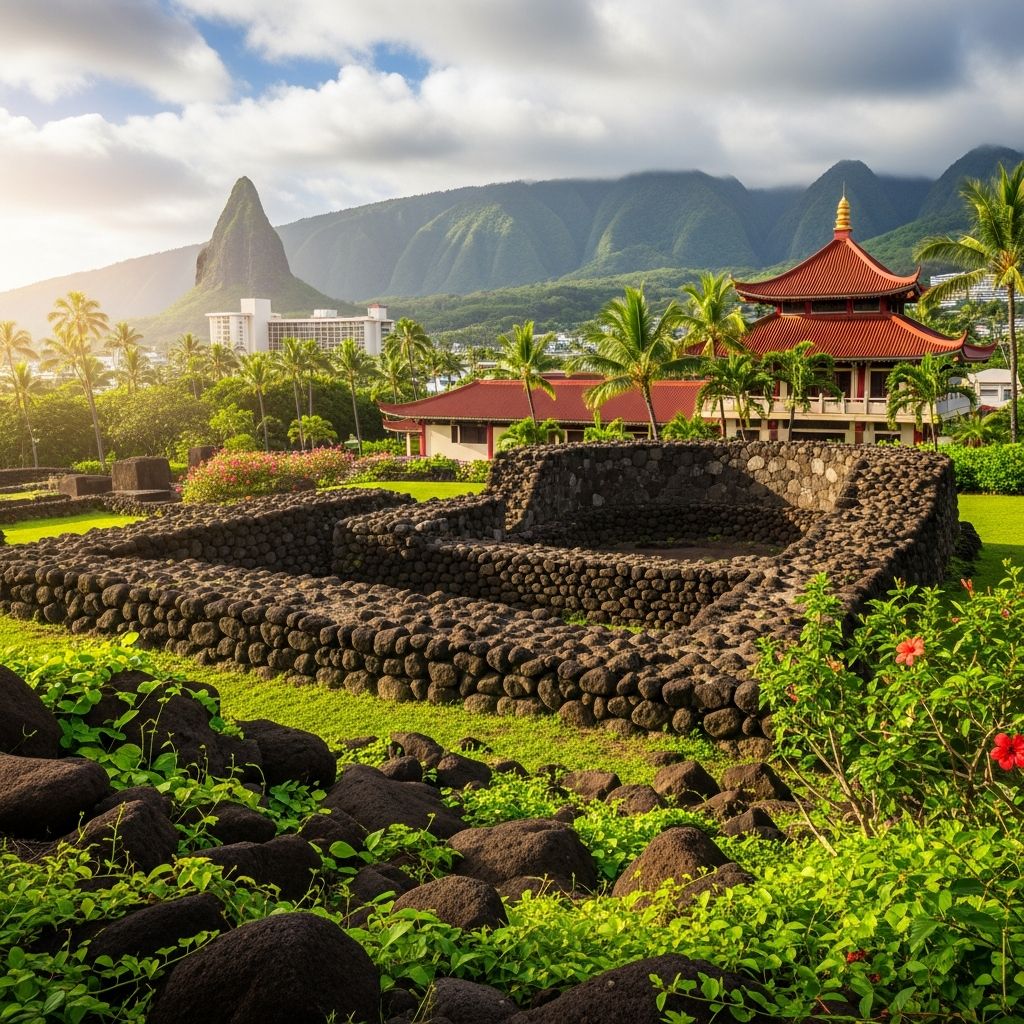
The Haleki’i-Pihana State Monument in Wailuku preserves two ancient heiau that dominated religious and political life in pre-contact Hawaiian society. These temple remains provide tangible connections to spiritual practices and social structures that organized community life for centuries. Informative interpretive panels help visitors understand the religious and political significance these structures held for ancient Hawaiians.
Kahanu Garden in Hana shelters Piʻilanihale Heiau, recognized as the largest ancient temple structure in all of Hawaii. This sacred site represents extraordinary construction achievements and demonstrates the advanced agricultural and spiritual knowledge Hawaiian communities possessed. The garden’s maintained plots showcase traditional Hawaiian farming techniques, revealing the sophistication of pre-contact agricultural systems.
European Exploration and Its Lasting Imprint
The arrival of European explorers marked a transformative moment in Maui’s history. In 1786, Captain Jean François de Galaup, Comte de La Pérouse, became the first European to step onto Maui’s shores. La Pérouse Bay, also known by its Hawaiian name Keoneʻōʻio, preserves the legacy of this initial contact. Located past Kihei and Wailea at the southernmost accessible point by vehicle on Maui, the bay features distinctive jagged lava rocks and accessible beach areas. Today, the landscape invites hikers and snorkelers to contemplate the historical significance of this early European-Hawaiian encounter.
Missionary Era: Religious Transformation and Cultural Influence
The 19th century brought Protestant missionaries who significantly altered Hawaiian religious and social landscapes. The Bailey House Museum, also known as Hale Hōʻikeʻike, occupies the former home of missionaries Dr. and Mrs. Titus Coan. This substantial structure, constructed from lava rock and koa wood, originally functioned as both a mission house and boarding school. Today, it operates as Maui’s largest and oldest history museum, housing approximately 2,000 Hawaiian artifacts alongside extensive archives of maps, manuscripts, biographies, and an impressive collection of 8,000 photographs.
Several churches erected during the missionary period continue to define Maui’s landscape and community identity. The Wananalua Congregational Church, established in 1838 in Hana, ranks among Maui’s oldest churches. This charming structure features traditional Hawaiian architectural elements and remains a cornerstone of local community life, hosting services and cultural events. The Ka’ahumanu Congregational Church, constructed in 1876 in Wailuku, honors Queen Ka’ahumanu, a prominent figure in Hawaiian history. Its charming architecture and lush grounds exemplify the missionary-era church architecture that became integral to Hawaiian communities.
The Hale Paʻi Printing Museum, also known as the House of Printing, represents a fascinating architectural blend of New England design adapted with materials indigenous to Hawaii. This structure preserves the history of missionary printing operations and demonstrates how foreign settlers adapted their architectural traditions to Hawaiian contexts and available resources.
The Sugar Industry Era: Economic Development and Social Change
Following the Great Māhele, a pivotal land division in Hawaiian history, foreign entrepreneurs established what became known as the Big Five—the five largest agricultural and sugarcane corporations in Hawaii. The sugarcane industry rapidly became the dominant economic force on Maui, fundamentally reshaping settlement patterns, labor structures, and cultural composition. Plantation owners recruited migrant workers from China, Japan, Korea, the Philippines, and Portugal, creating a multicultural workforce that permanently altered island demographics.
The Alexander & Baldwin Sugar Museum documents this industrial transformation through interactive exhibits. Visitors encounter vintage machinery, historical photographs, and comprehensive displays detailing the sugar industry’s rise and eventual decline on Maui. This museum provides essential context for understanding how 19th and 20th-century economic forces reshaped Hawaiian society and landscape.
The Hui No’eau Visual Arts Center, situated in Makawao within a beautifully restored 1917 plantation estate, illustrates how industrial heritage structures have been repurposed for contemporary cultural expression. Originally connected to the sugarcane industry, the estate now hosts art exhibitions, classes, and workshops, serving as a vibrant cultural hub. Guided tours highlight the estate’s historical role in the sugar economy while celebrating its current function as an artistic venue.
The Haiku Mill, a lovingly restored 19th-century sugar processing facility in Haiku, offers guided tours that trace the mill’s journey from industrial operation to modern venue space. While now used for events and celebrations, the mill’s historical context remains accessible to visitors interested in understanding Maui’s industrial heritage.
Lahaina: Historical Heart of the Kingdom
Lahaina holds extraordinary significance as the former capital of the Hawaiian Kingdom and remains central to understanding Maui’s historical importance. The Maui Historical Society preserves extensive photographic and documentary records illustrating Lahaina’s evolution across different eras, from the whaling industry period through the plantation age. Historical images of the Pioneer Inn, Lahaina Courthouse, the iconic Banyan Tree, and waterfront development chronicle the community’s transformation across centuries.
Cultural and Educational Institutions
Beyond historical sites, contemporary institutions actively preserve and interpret Maui’s heritage. The Maui Ocean Center aquarium connects marine biodiversity to Maui’s historical relationship with ocean resources. Educational exhibits explain how the ocean’s critical role shaped Maui’s cultural and economic development.
The Hui No’eau Visual Arts Center celebrates Maui’s artistic heritage through galleries showcasing local and international artists. Workshops and demonstrations invite deeper engagement with the island’s creative spirit and contemporary cultural expression.
Experiencing Historical Maui: Practical Considerations
| Historical Site | Location | Primary Historical Focus | Best Activities |
|---|---|---|---|
| Iao Valley State Monument | Central Maui | Ancient battles and Hawaiian governance | Hiking, educational exhibits |
| La Pérouse Bay | South Maui | First European contact | Snorkeling, hiking |
| Bailey House Museum | Wailuku | Hawaiian culture and missionary influence | Museum tours, artifact viewing |
| Alexander & Baldwin Sugar Museum | Central Maui | Sugarcane industry and immigration | Interactive exhibits, machinery tours |
| Kahanu Garden | Hana | Ancient temples and agriculture | Garden walks, temple exploration |
| Historic Churches | Various locations | Missionary era and religious history | Architecture tours, services |
Connecting Past and Present on Maui
Maui’s historical landscape reflects centuries of cultural interaction, economic transformation, and community resilience. From sacred Hawaiian temples and missionary churches to industrial heritage sites and colonial landing points, the island preserves a multifaceted historical record. These sites collectively tell stories of indigenous civilization, foreign contact, cultural adaptation, and economic development that shaped modern Hawaii.
Visitors exploring Maui’s historical attractions gain deeper appreciation for the complex forces that created contemporary Hawaiian society. Understanding this heritage enriches island experiences and honors the diverse peoples whose actions and choices formed the Maui of today.
Frequently Asked Questions
- When did the first Polynesians arrive in Hawaii?
- Polynesians from the Marquesas Islands and Tahiti voyaged to Hawaii around 1000 CE, settling near Ma’alaea Harbor on Maui and establishing the foundation of Hawaiian culture.
- What is the significance of the Battle of Kepaniwai?
- Fought in 1790 at Iao Valley, this battle was crucial to King Kamehameha I’s campaign to unify the Hawaiian Islands under single rule.
- Who was the first European to reach Maui?
- Captain Jean François de Galaup, Comte de La Pérouse, was the first European to land on Maui’s shores in 1786, with La Pérouse Bay named in his honor.
- How did the sugar industry transform Maui?
- The sugarcane industry became the island’s primary economic driver, attracting migrant workers from Asia and Europe, fundamentally altering Maui’s demographics and landscape.
- Where can I learn about missionary influence on Hawaii?
- The Bailey House Museum, Hale Paʻi Printing Museum, and various historic churches like Wananalua Congregational Church document missionary impact on Hawaiian religious and cultural life.
References
- Unveiling Maui’s Past: Exploring Historical Sites, Museums and Ancient Legends — Wailea Ekahi Village. https://waileaekahivillage.com/blog/unveiling-mauis-past-exploring-historical-sites-museums-and-ancient-legends/
- Unveiling Maui’s Rich History: 2024 Guide to Historical Sites — Vacation Maui. https://www.vacation-maui.com/blog/unveiling-mauis-rich-history-2024-guide-historical-sites
- Maui Landmarks: Things to do on Maui — SpeediShuttle. https://www.speedishuttle.com/maui-landmarks
- Museums in Maui: A Cultural Journey Through Hawaiʻi — Maui Ocean Center. https://mauioceancenter.com/activities/museums-in-maui-a-cultural-journey-through-hawai%CA%BBi/
- 15 Places to Learn About the History of Maui — Lonely Planet. https://www.lonelyplanet.com/articles/places-to-see-history-of-maui
- Maui Historical Society — Maui Museum. https://mauimuseum.org
Similar Articles





Read full bio of Sneha Tete