Mount Rushmore: History, Construction, And Visiting Guide
Discover the fascinating history and engineering behind one of America's most iconic sculptures carved into South Dakota's Black Hills.
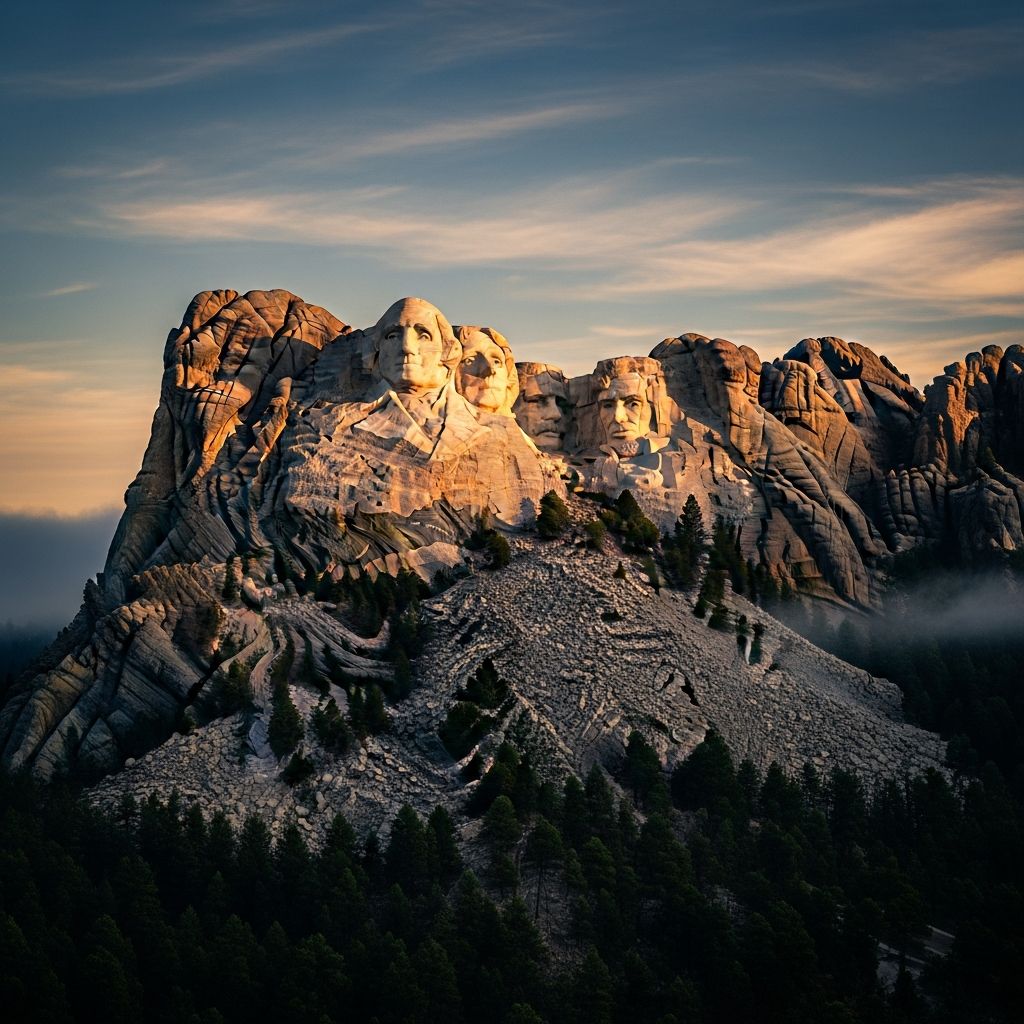
Mount Rushmore National Memorial stands as one of the most recognizable symbols of American identity, featuring the colossal carved faces of four U.S. presidents set against the dramatic landscape of South Dakota’s Black Hills. This monumental sculpture has captivated millions of visitors since its completion in 1941, serving not only as a testament to American engineering and artistic vision but also as a focal point for discussions about national heritage, historical interpretation, and cultural perspectives. The monument attracts approximately two to three million visitors annually, making it one of the most heavily visited National Park Service properties in the United States.
The Genesis of an American Vision
The concept for Mount Rushmore emerged from practical tourism considerations rather than grand artistic aspirations. In 1923, Doane Robinson, a South Dakota historian and journalist, conceived the idea of carving likenesses into the granite faces of the Black Hills as a means to draw tourist traffic to the region. Robinson’s initial vision was far different from what ultimately materialized. He envisioned sculpting Western historical figures including Oglala Lakota leader Red Cloud, the explorers Lewis and Clark, and Buffalo Bill Cody into a nearby rock formation called the Needles.
Robinson’s plan underwent a dramatic transformation when sculptor Gutzon Borglum entered the project. Rather than preserving regional Western history, Borglum redirected the monument’s purpose toward celebrating pivotal moments in American national development. His reinterpretation shifted the project from a regional attraction into a political and patriotic statement, transforming Robinson’s tourism venture into a monument commemorating the nation’s founding, territorial expansion, preservation during internal conflict, and industrial development.
Four Presidents and Their Symbolic Meanings
The selection of the four presidents depicted on the mountain reflects carefully considered historical narratives about American progress and national character. Each president’s placement and the face size—measuring 60 feet in height—contributes to the monument’s overarching message about American development.
George Washington appears first in the sequence, representing the nation’s founding principles and the establishment of constitutional democracy. As the first president and a revolutionary leader, Washington embodies the creation of a new nation based on Enlightenment ideals.
Thomas Jefferson symbolizes territorial expansion and the nation’s westward growth. His association with the Louisiana Purchase and the vision of continental expansion positioned him as a figure representing American ambition and developmental philosophy during the early republic.
Theodore Roosevelt represents the nation’s conservation efforts and industrial growth during the early twentieth century. Roosevelt’s role in establishing national parks and his presidency during America’s emergence as an industrial power made him an appropriate symbol for the nation’s environmental stewardship and economic development.
Abraham Lincoln embodies perseverance and national preservation, having led the country through its Civil War and the abolition of slavery. His inclusion underscores the monument’s narrative of American resilience and the nation’s commitment to maintaining union and freedom.
The Engineering Marvel: Construction and Innovation
The actual carving of Mount Rushmore commenced in 1927 and proceeded until 1941, spanning a 14-year construction period that involved remarkable engineering ingenuity and dangerous working conditions. A workforce exceeding 400 workers labored to bring Borglum’s vision to life, carving approximately 1.2 million tons of granite from the mountainside using primarily dynamite-based excavation techniques.
One of the most notable achievements of the construction project was the absence of worker fatalities throughout the entire process. Despite the hazardous nature of blasting, carving, and working at extreme heights, no workers died during construction—a remarkable safety record for such a dangerous undertaking during the 1930s and 1940s.
Borglum employed innovative technological methods to ensure precision in the massive undertaking. He developed a specialized pointing machine based on a 1:12 scale model of the final sculpture, allowing workers to accurately map the image onto the mountain face. This technology enabled the sculptors to achieve proper proportions and detailed facial features despite the colossal scale of the project.
The original conception for Mount Rushmore extended beyond the faces visible today. Initial plans called for the presidents’ figures to be carved from head to waist, a far more ambitious design than what ultimately appeared on the mountain. Jefferson’s face required relocation due to geological instability in the rock, necessitating redesign and adjustments to the overall composition.
Borglum’s Secret Project: The Hall of Records
In 1938, sculptor Gutzon Borglum embarked on a clandestine project that would have fundamentally altered Mount Rushmore’s appearance. He began secretly blasting a chamber into the mountain behind Lincoln’s head, intending to create a Hall of Records that would serve as a historical vault.
This hidden chamber was designed to contain vital American documents, including the Constitution, Declaration of Independence, and other historical records deemed essential to preserving the nation’s heritage. Borglum envisioned the Hall of Records as a time capsule for future generations, physically embedding American history into the mountain monument.
Congress intervened in this ambitious plan, discovering Borglum’s covert work and demanding that federal funding be directed toward completing the presidential faces rather than the hall. The project was abandoned, though the incomplete chamber remains within the mountain. This controversy highlights the tensions between artistic vision and governmental oversight, as well as differing conceptions about how historical narratives should be preserved and presented.
The Human Cost and Legacy of Borglum
Gutzon Borglum’s leadership of the Mount Rushmore project defined his career, though his death in March 1941 left the monument incomplete. His son, Lincoln Borglum, assumed leadership of the project and completed the work according to his father’s specifications. Gutzon Borglum had been a celebrated sculptor before Mount Rushmore, known for other significant works and innovative approaches to monumental sculpture.
The Sculptor’s Studio, now part of the monument’s visitor facilities, preserves the workspace where Borglum developed scale models and refined designs for Mount Rushmore. This location offers visitors insight into the technical and creative processes behind the sculpture’s conception and execution.
Visiting Mount Rushmore: Modern Facilities and Experience
Contemporary Mount Rushmore offers visitors comprehensive facilities designed to educate and entertain while accommodating the enormous volume of annual visitors. The site includes multiple distinct areas and attractions:
- Visitor Center: Provides orientation, information, and amenities for the millions of annual visitors navigating the site
- Lincoln Borglum Museum: Features multimedia exhibits exploring the monument’s construction, the presidents depicted, and Borglum’s artistic vision. Interactive displays include an old-style explosives plunger that visitors can operate to simulate the dynamite blasting process
- Sculptor’s Studio: Preserves the workspace where Borglum and his team developed scale models and refined the monument’s design. The studio sits at the top of the Grand View Terrace, accessible via 422 stairs from the lower parking area
- Presidential Trail: A 0.5-mile walking path offering varied perspectives of each presidential face and intimate engagement with the monument
- Avenue of Flags: Leads to the Grand View Terrace and features flags representing all 50 states, the District of Columbia, three U.S. territories, and two U.S. commonwealths
The Grand View Terrace, positioned above the museum, provides one of the most photographed vantage points for observing the complete monument. The terrace offers optimal viewing angles and serves as a gathering space for visitors to contemplate the sculpture’s majesty.
Cultural and Historical Complexities
While Mount Rushmore celebrates American historical narratives, the monument’s location and creation involve significant cultural complexities. The Black Hills region holds profound sacred significance for the Sioux Nation and other Native American tribes. The U.S. government obtained these lands in violation of the Fort Laramie Treaty of 1868, a historical injustice that continues to resonate with Native American communities.
The monument has served as a focal point for Native American activism and protest, particularly during the 1970s American Indian Movement demonstrations. These protests highlighted the monument’s representation of American history from a colonizer’s perspective, raising important questions about whose narratives are commemorated in national monuments and whose histories are marginalized.
The Crazy Horse Memorial, another monumental sculpture in the Black Hills, emerged partly in response to Mount Rushmore. Dedicated to honoring Native American heritage and leadership, the Crazy Horse Memorial represents an alternative narrative about the region’s history and cultural significance.
The Nomination and Naming Mystery
The monument’s name derives from Charles E. Rushmore, a New York lawyer who traveled to the Black Hills in 1884 or 1885 to verify legal property titles. Though Rushmore himself had no direct connection to the sculpture, the mountain where the monument was carved had become known by his name, and this geographic designation persisted through the monument’s development and construction.
Practical Visitor Information
Mount Rushmore operates under National Park Service management, which has maintained responsibility for the memorial’s care and operations since 1933. The National Park Service oversees preservation efforts, visitor services, educational programming, and maintenance of the carved sculpture and surrounding facilities.
The monument’s accessibility has continuously improved over decades to accommodate the growing numbers of visitors. Infrastructure improvements have enhanced visitor facilities, created accessible pathways, expanded parking and restroom facilities, and developed educational resources that cater to diverse visitor interests and physical abilities.
Mount Rushmore’s Enduring Significance
Mount Rushmore represents a convergence of American artistic ambition, political symbolism, engineering innovation, and historical narrative. The monument embodies mid-twentieth-century perspectives on American history while simultaneously inviting contemporary viewers to reconsider how national stories are constructed, whose perspectives are represented, and what symbols best express collective identity.
The sculpture continues to captivate visitors as a remarkable testament to human determination and creative vision. Whether understood primarily as an artistic achievement, a historical commemoration, or a focal point for discussing American identity and cultural representation, Mount Rushmore remains an undeniably significant landmark that merits continued critical engagement alongside appreciation for its engineering accomplishment.
References
- Mount Rushmore National Memorial Facts and History — U.S. National Park Service. Accessed 2026. https://www.nps.gov/moru/
- Mount Rushmore: Dynamite Facts and Surprising History — Travel South Dakota. https://www.travelsouthdakota.com/trip-ideas/surprising-facts-about-mount-rushmore
- Mount Rushmore National Memorial | Facts, Location, & History — Britannica. https://www.britannica.com/topic/Mount-Rushmore-National-Memorial
- On the Many—and Contradictory—Histories of Mt. Rushmore — LitHub. https://lithub.com/on-the-many-and-contradictory-histories-of-mt-rushmore/
- 9 Fun Facts About Mount Rushmore — Rustic Pathways. https://rusticpathways.com/blog/fun-facts-about-mount-rushmore
Similar Articles






Read full bio of Sneha Tete