
Nature’s Deceptions: Understanding Atmospheric Visual Phenomena
Explore the science behind Earth's most captivating atmospheric illusions
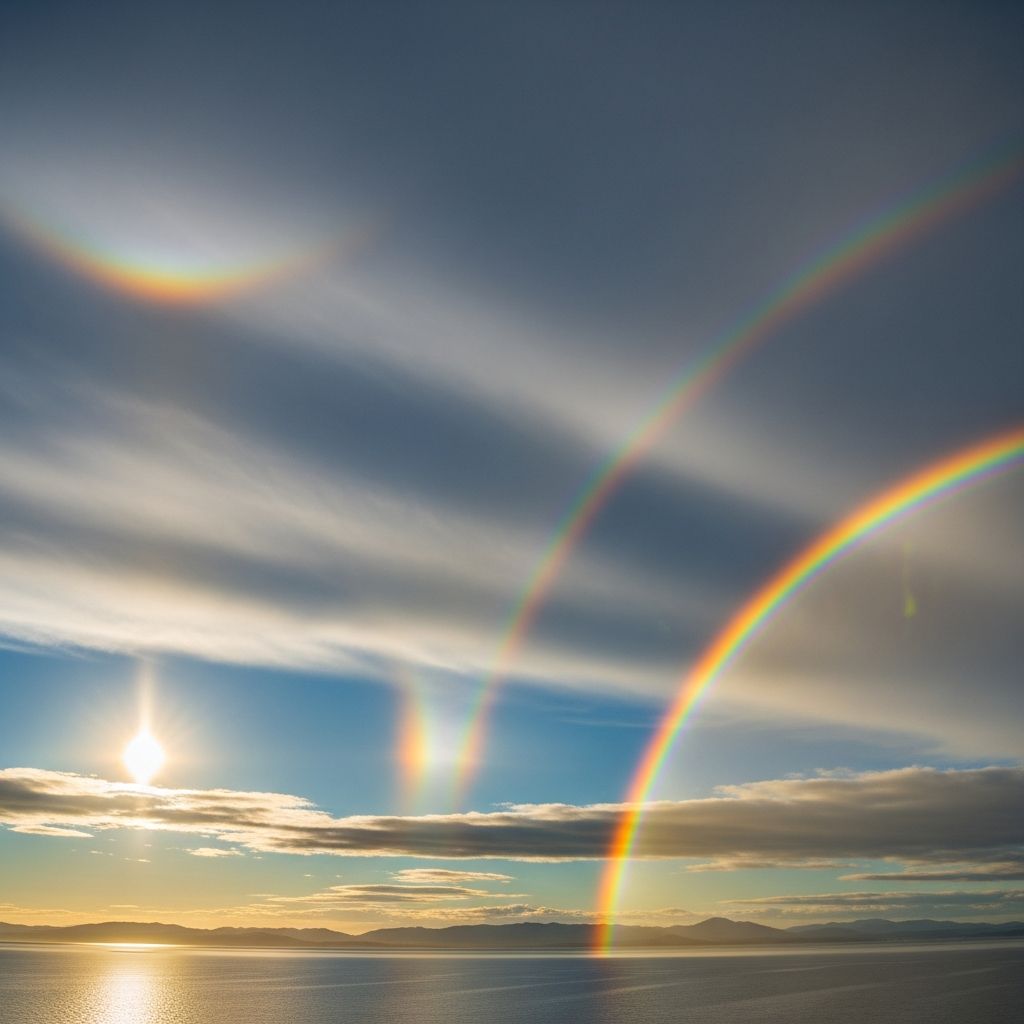
Throughout human history, travelers and explorers have witnessed extraordinary visual displays in the atmosphere that seemed to defy explanation. These phenomena range from impossible floating islands to glowing halos surrounding shadows, each representing a fascinating intersection of physics, light, and atmospheric conditions. What once appeared as divine intervention or supernatural occurrence is now understood through the lens of science. Today, we explore the mechanisms behind these captivating visual effects that continue to mesmerize observers across diverse environments on our planet.
Light Bending and Mirages: The Fata Morgana Effect
Among the most complex atmospheric illusions exists the Fata Morgana, a phenomenon that has confounded explorers and scientists for centuries. This superior mirage creates stacked, distorted images that often appear completely unrecognizable from their original source. The effect involves light rays bending as they pass through air layers with dramatically different temperatures, creating what scientists call an atmospheric duct that functions similarly to a refracting lens.
The Fata Morgana requires specific conditions to manifest: a thermal inversion where warmer air sits above colder, denser air, combined with the formation of an atmospheric duct. Unlike simple mirages, thermal inversion alone cannot produce this complex phenomenon; the atmospheric duct must be present as a prerequisite. When these conditions align, observers witness multiple inverted and upright images stacked vertically, displaying alternating compressed and stretched zones that shift and change rapidly.
Arctic expeditions have provided some of the most dramatic documented cases. In 1818, expedition crews famously observed what appeared to be towering mountains in the Arctic, which they christened the Croker Mountains—features that subsequent searches could never locate. These phantom landscapes resulted from Fata Morgana distortions that rendered distant objects entirely unrecognizable. The phenomenon can involve boats, coastal features, islands, or virtually any distant object, making it particularly treacherous for maritime navigation in polar regions.
The Dance of Polar Illumination: Aurora Borealis and Australis
Among Earth’s most breathtaking natural spectacles rank the polar lights, representing nature’s grandest light show. These phenomena, known scientifically as aurora borealis in the Northern Hemisphere and aurora australis in the Southern Hemisphere, transform the extended darkness of polar winters into luminous displays of extraordinary beauty.
The mechanism driving these celestial performances involves a complex interplay between solar activity and Earth’s magnetic environment. When violent explosions occur on the sun’s surface, they eject charged particles into space. These solar particles travel toward Earth, where they are captured by the planet’s magnetic field and directed toward the polar regions. Upon entering the atmosphere near the poles, these particles collide with atmospheric gases, particularly oxygen and nitrogen, causing them to emit photons—units of light energy.
The resulting displays showcase colors ranging from brilliant green and red to white, purple, and blue luminescence. The variety of colors depends on which atmospheric gases the solar particles encounter and the altitude at which collisions occur. For millennia, those fortunate enough to witness these displays believed they were observing divine manifestations or experiencing profound spiritual transformation. The sheer magnitude and otherworldly character of auroras made them irresistible subjects for mythological interpretation across cultures.
The Shadow with a Halo: The Brocken Spectre Mystery
High mountain peaks frequently serve as stages for one of nature’s most dramatic optical performances: the Brocken Spectre. This phenomenon manifests as an enormous shadow of the observer projected onto clouds or thick mist below, often surrounded by concentric rings of rainbow-colored light.
The effect typically occurs when specific atmospheric and solar conditions converge. An observer standing on elevated terrain experiences the sun positioned behind them while clouds or fog layers exist below. Under these circumstances, the observer’s shadow stretches and magnifies dramatically across the cloud surface. The surrounding rainbow rings, known scientifically as a glory, result from sunlight interacting with tiny water droplets suspended in the atmosphere. These droplets scatter light back toward the observer, creating the characteristic colorful halos that typically surround the magnified head of the shadow figure.
The phenomenon derives its name from the Brocken, the highest peak in the Harz Mountains within Germany’s Saxony-Anhalt region, standing at 1,141 meters elevation. The mountain’s prominence and frequent cloud formations made it an ideal location for observing this remarkable effect, and historical accounts of Brocken Spectre sightings contributed significantly to its identification and naming.
Atmospheric Electricity: St. Elmo’s Fire and Divine Omens
Among the most electrically dramatic phenomena occurs what sailors and mountaineers call St. Elmo’s Fire, a luminous discharge of atmospheric electricity that appears as glowing light manifestations. This effect results from the discharge of electrical energy accumulated in storm clouds being transferred to the Earth through pointed objects like ship masts or mountain peaks.
The historical significance of St. Elmo’s Fire cannot be overstated. Maritime traditions held that the appearance of this phenomenon indicated divine favor or supernatural intervention. Sailors experiencing St. Elmo’s Fire during storms often welcomed the sight, as it typically coincided with the point where intense storm conditions began moderating. The glowing display seemed to herald salvation and the passage of danger, transforming fear into hope during perilous maritime conditions.
In Scotland, the phenomenon is frequently observed on the heights of Edinburgh’s Castle Rock, where atmospheric and topographic conditions frequently combine to produce these spectacular electrical displays. Modern understanding has replaced mystical interpretation with electromagnetic theory, yet the visual impact remains equally striking to contemporary observers.
The Emerald Ray: The Green Flash Phenomenon
At the precise moment when the sun touches the horizon during sunset, observers with clear skies and unobstructed ocean views sometimes witness an extraordinary optical event: a brilliant green light appearing to shoot outward from the sun’s position. This fleeting phenomenon, lasting mere seconds, has captivated romantics and scientists alike, seeming to encapsulate the ephemeral and transcendent aspects of existence.
The Green Flash results from complex interactions involving light refraction, atmospheric thickness variations, and Earth’s curvature. As light from the sun passes through the atmosphere at sunset, different wavelengths refract at slightly different angles. The atmosphere acts as a thick, graduated lens, bending light rays and dispersing them by color. Red wavelengths, being longer, refract less sharply than blue-green wavelengths. At the precise moment of sunset, the remaining visible light becomes compressed into the blue-green spectrum, creating the distinctive green ray or flash effect.
The phenomenon occurs most reliably when observing from locations with clear atmospheric conditions and unobstructed horizons, particularly maritime settings. Desert observers with particularly clear atmospheric visibility also report green flash sightings, though the effect manifests less frequently than in oceanic locations.
Heat and Refraction: Understanding Mirages in Deserts and on Roadways
One of the most commonly observed optical illusions worldwide involves the deceptive appearance of water or wet surfaces on hot terrain. This phenomenon, commonly called a mirage, presents a cruel paradox for exhausted travelers in desert environments: the shimmer of what appears to be water or moisture evaporates into reality as one approaches.
The mechanism involves differential heating of air layers close to hot surfaces. Sand, asphalt, and other dark materials absorb solar radiation intensely, heating the air immediately above them to extreme temperatures. This heated air becomes less dense than the cooler air above it, creating distinct temperature boundaries. Light rays passing through these layers of varying density refract or bend, following curved paths rather than traveling in straight lines. To observers at distance, these refracted light rays appear to come from the ground surface, creating the illusion of reflected sky—indistinguishable from water reflection in appearance.
The philosophical paradox of the mirage captures human imagination: the illusion simultaneously represents hope and disappointment for desert travelers. Modern road travelers in vehicles experience the phenomenon differently, viewing the heat shimmer as atmospheric decoration enhancing the journey rather than torment. The same optical mechanism produces vastly different psychological effects depending on context and observer circumstance.
Mock Suns and Ice Crystal Prisms: Understanding Sun Dogs
Another striking atmospheric phenomenon involves the appearance of bright spots of light flanking the sun on either side, creating an arrangement resembling three suns along the horizon. These apparitions, called sun dogs or using the more formal term parhelia, result from ice crystals suspended in the atmosphere creating natural prism effects.
Sun dogs can persist for extended periods, sometimes remaining visible for hours as atmospheric ice crystal conditions remain stable. Throughout history, these displays generated significant cultural concern. Ancient observers interpreted multiple suns as ominous portents predicting imminent catastrophe, famine, or divine displeasure. The sight seemed to herald cosmic disorder and terrestrial misfortune. Contemporary understanding recognizes these phenomena as innocent optical effects created by atmospheric ice crystals refracting sunlight into distinctive patterns.
The optimal viewing conditions involve flat horizons offering unobstructed views of the sun at low angles. Desert and prairie environments, including locations like the baked-sand vistas surrounding Timbuktu with its ancient mud architecture, provide ideal settings for observing this phenomenon. The crystalline nature of ice particles makes them effective light-bending media, creating the characteristic bright spots that flanked the sun through human history.
Atmospheric Clarity and Depth Perception Distortions
Polar regions and high-altitude environments create distinctive optical challenges due to extraordinarily clear atmospheric conditions. The pure, unpolluted air characteristic of polar zones brings distant objects into sharp focus, yet paradoxically makes accurate distance assessment nearly impossible.
In these extreme environments, depth perception becomes fundamentally compromised. The exceptional clarity eliminates many visual cues humans typically use to judge distance—atmospheric haze, intermediate landmarks, and perspective gradients become unreliable or absent entirely. Observers experience a disorienting two-dimensional quality to the visible world, where distant mountains and nearby objects appear to exist in similar spatial relationships.
Early explorers meticulously recorded on maps and charts numerous features they observed in polar regions—islands, headlands, and mountain ranges—that subsequent expeditions could never relocate. These phantom geographical features resulted not from intentional deception but from the fundamental limitations imposed by unusual atmospheric clarity on human depth perception. The explorers genuinely observed visual phenomena; the phenomena simply didn’t correspond to actual geographical features positioned where they appeared to exist.
Frequently Asked Questions About Atmospheric Optical Phenomena
What distinguishes a mirage from a Fata Morgana?
Mirages involve simple refraction of light through a single temperature boundary, creating a single inverted image. Fata Morgana represents a complex phenomenon requiring an atmospheric duct formation, producing multiple stacked images that distort and change rapidly, often rendering the original object completely unrecognizable.
Can auroras be predicted in advance?
Auroral displays depend on solar activity levels, which vary unpredictably. Space weather forecasts can indicate increased probability during periods of solar storm activity, but precise prediction remains impossible. Location within high-latitude regions substantially increases observation probability.
How does the Brocken Spectre differ from ordinary shadows?
Ordinary shadows appear as dark projections on surfaces. The Brocken Spectre involves dramatic magnification of the observer’s shadow combined with a distinctive halo of rainbow-colored light created by light scattering through atmospheric water droplets.
Why does the Green Flash appear green rather than other colors?
As sunlight refracts through Earth’s thick atmosphere during sunset, longer red wavelengths refract less than shorter blue-green wavelengths. The remaining visible light becomes concentrated in the green-blue spectrum at the precise moment of solar setting.
What weather conditions optimize mirage observation?
Clear, still conditions with extreme temperature differentials between air layers and ground surfaces create optimal mirage conditions. Calm conditions without wind turbulence preserve the distinct air layer boundaries essential for mirage formation.
The Intersection of Science and Wonder
These atmospheric optical phenomena represent the extraordinary beauty achievable when physics operates within natural environmental conditions. Each effect demonstrates how light, temperature, atmospheric composition, and Earth’s physical characteristics combine to create visual experiences that transcend simple explanation. What historical observers attributed to divine intervention or supernatural activity now yields to scientific understanding while remaining visually spectacular.
Modern observers possess the advantage of understanding the mechanisms generating these phenomena, yet this knowledge arguably enhances rather than diminishes appreciation for their occurrence. The precise orchestration of conditions required for each effect’s manifestation—from polar magnetic field interactions to specific temperature inversions to ice crystal alignments—represents remarkable natural complexity. These phenomena endure as testament to the intricate physical systems governing our planet’s atmosphere and the spectacular visual displays emerging from their interaction with light and human perception.
References
- Believe your eyes: the world’s strangest optical illusions and mirages — Lonely Planet. https://www.lonelyplanet.com/articles/believe-your-eyes-the-worlds-strangest-optical-illusions-and-mirages
- Fata Morgana (mirage) — Wikipedia. https://en.wikipedia.org/wiki/Fata_Morgana_(mirage)
- 20 mind-boggling optical illusions you can find in nature — Business Insider. https://www.businessinsider.com/optical-illusions-in-nature-photos
- The Mystery of Mirages — Parinama Academy. 2024-02-12. https://parinama.academy/2024/02/12/the-mystery-of-mirages/
- Mirages and Fog — San Diego State University. https://aty.sdsu.edu/mirages/fog.html
- 35 optical illusions and why they trick your brain — Live Science. https://www.livescience.com/health/mind/32-optical-illusions-and-why-they-trick-your-brain
Similar Articles







Read full bio of medha deb