Taj Mahal: A Complete Travel & Historical Guide
Discover the architectural masterpiece and romantic legacy of India's most iconic monument
The Monument That Defines Eternal Love
Standing majestically on the banks of the Yamuna River in Agra, Uttar Pradesh, the Taj Mahal represents far more than architectural excellence—it embodies one of history’s most poignant love stories. This ivory-white marble mausoleum has captivated millions of visitors worldwide and remains India’s most recognizable symbol of devotion and artistic achievement. Built during the 17th century by Mughal Emperor Shah Jahan, the monument stands as a testament to both personal grief and imperial ambition, creating a structure that transcends time and cultural boundaries.
The name “Taj Mahal” derives from Persian, translating to “Crown of Palaces,” a fitting designation for what many consider the world’s most beautiful building. Since its completion in the mid-17th century, this architectural wonder has drawn scholars, artists, and travelers who come to witness its ethereal beauty and understand the historical circumstances that inspired its creation.
Origins: A Love Story Carved in Marble
The genesis of the Taj Mahal traces back to a profound personal tragedy that would reshape the landscape of India. Shah Jahan, the fifth ruler of the Mughal dynasty, ascended to the throne in 1628 and ruled until 1658. During the early years of his reign, tragedy struck when his third wife and most beloved companion, Mumtaz Mahal, died in 1631 while giving birth to their fourteenth child. Mumtaz Mahal was not merely a consort but Shah Jahan’s inseparable companion since their marriage in 1612, making her death an irreplaceable loss for the grieving emperor.
Rather than succumb to his sorrow, Shah Jahan channeled his anguish into creating an immortal memorial to his beloved. The emperor commissioned construction of what would become the Taj Mahal almost immediately following her death. Contemporary Mughal texts referred to it as the “Luminous Tomb,” a name that captures both its radiant appearance and its spiritual significance as a beacon of everlasting love and remembrance.
The commissioning occurred in 1631, with actual construction commencing in 1632. This ambitious project would occupy the next two decades, becoming one of the most significant architectural undertakings of the Mughal era.
Architectural Brilliance and Design Innovation
The Taj Mahal complex showcases a remarkable fusion of architectural styles and engineering brilliance. The chief architect is traditionally credited to Ustad Ahmad Lahawri, an Indian of Persian descent, though various architects from the period contributed to the overall design. The result is a harmonious blend of Islamic, Persian, and Indian architectural traditions, creating something entirely unique and universally admired.
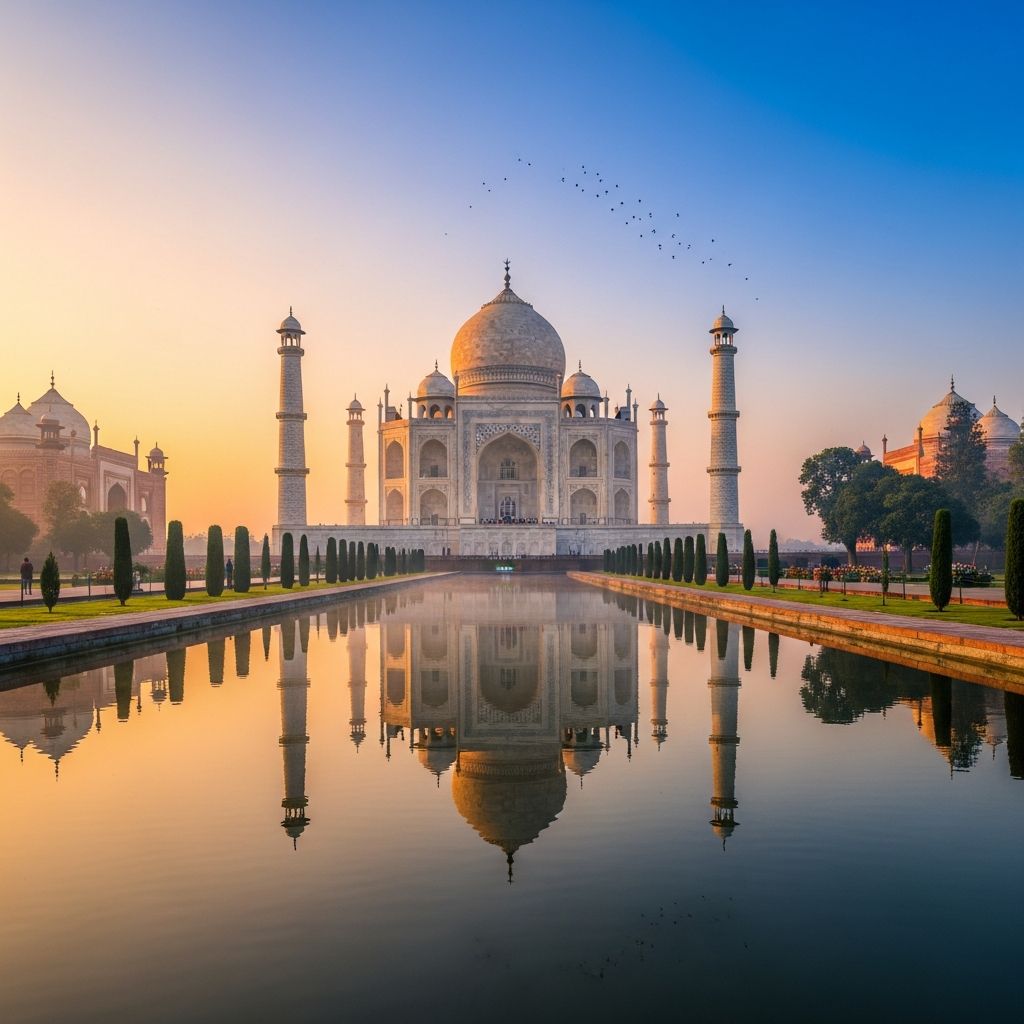
The main mausoleum sits atop a high red sandstone platform topped by an expansive white marble terrace. The structure itself rises majestically, crowned by an enormous white marble dome flanked by four tapering minarets. This symmetrical arrangement creates visual harmony from every angle, with the white marble seeming to glow differently throughout the day, reflecting the changing light.
Inside the dome lies the jewel-inlaid cenotaph of Mumtaz Mahal, adorned with semi-precious stones in intricate floral and geometric patterns. The workmanship is so exquisite that contemporary observers described the monument as “having been designed by giants and finished by jewellers.” The marble surfaces are inlaid with jade, crystal, turquoise, and semi-precious stones, creating elaborate decorative patterns that cover virtually every visible surface.
Structural Components
- Main Mausoleum: The central structure housing the cenotaphs of both Mumtaz Mahal and Shah Jahan, featuring the iconic white marble dome
- Red Sandstone Gateway: The monumental entrance structure providing access to the complex grounds
- Mosque: A functioning place of worship positioned to the west of the mausoleum
- Jawab (Answer Building): A mirror structure to the mosque, maintaining architectural symmetry and balance
- Formal Gardens: Meticulously planned landscaped grounds featuring geometric patterns, water channels, and flowering vegetation
- Boundary Wall: A crenellated defensive wall surrounding three sides of the complex
Construction Timeline and Workforce
The construction of the Taj Mahal represents one of history’s greatest mobilization of human resources and craftsmanship. Beginning in 1632, the project employed approximately 22,000 workers, including artisans, laborers, and craftsmen drawn from India, Persia, the Ottoman Empire, and Europe. This international assembly of talent brought diverse skills and perspectives to the project, enriching the final product with varied influences.
The mausoleum structure itself was substantially completed by 1638-39, with Shah Jahan himself participating in commemorative ceremonies before its final completion. On February 6, 1643, the emperor observed the 12th anniversary of Mumtaz Mahal’s death at the partially completed mausoleum, marking a significant milestone in the project. Adjunct buildings were finished by 1643, though decorative work continued until at least 1647. The entire 42-acre complex was considered complete by 1653, representing 22 years of continuous labor.
The workforce faced considerable logistical challenges, including the transportation of materials across vast distances. Over 1,000 elephants were employed to haul stone and marble, while craftsmen worked in coordinated teams to ensure precision in every detail. At the time, the total construction cost reached approximately 32 million rupees—an astronomical sum equivalent to roughly 827 million U.S. dollars in 2015 currency values.
The Controversial Black Taj Theory
One of history’s most intriguing mysteries surrounding the Taj Mahal involves the alleged “Black Taj” that Shah Jahan supposedly planned as his own mausoleum. According to a tradition documented by Jean-Baptiste Tavernier, the French traveler who visited Agra in 1665, Shah Jahan intended to construct a mirror structure on the opposite bank of the Yamuna River using black marble. This black mausoleum was supposedly connected to the white Taj Mahal by a bridge, creating a symmetrical pair representing the eternal union of the emperor and his wife.
However, Shah Jahan’s deposition in 1658 by his son Aurangzeb interrupted these plans. Aurangzeb, who disagreed with his father on numerous issues, particularly opposed the black marble project and imprisoned Shah Jahan in Agra Fort for the remainder of his life. While the romantic black Taj narrative has captivated imaginations for centuries, some historians have dismissed it as legend rather than historical fact, arguing insufficient evidence supports the claim.
Notably, Shah Jahan was eventually interred alongside his beloved wife within the white marble mausoleum—though uniquely, his cenotaph remains the only asymmetrical element in the entire complex, positioned beside rather than in perfect alignment with Mumtaz Mahal’s tomb, having been added as an afterthought.
World Recognition and Heritage Status
The Taj Mahal’s significance extends far beyond India’s borders. In 1983, UNESCO designated it as a World Heritage Site, recognizing it as “the jewel of Islamic art in India and one of the universally admired masterpieces of the world’s heritage.” This prestigious designation acknowledges the monument’s exceptional cultural, artistic, and historical value to humanity.
In 2007, the Taj Mahal received additional global recognition when it was named one of the New Seven Wonders of the World, cementing its status as one of humanity’s greatest achievements. The monument attracts over five million visitors annually, making it one of India’s most visited tourist attractions and generating significant cultural and economic impact for the Agra region.
Within India, the Taj Mahal holds status as a Monument of National Importance and is administered by the Archaeological Survey of India, ensuring preservation and protection of this irreplaceable cultural asset for future generations.
Planning Your Visit to the Taj Mahal
Best Times to Visit
Timing your visit strategically enhances the experience significantly. The monument remains open to visitors year-round, but seasonal variations affect comfort and visibility. October through March represents the optimal visiting period, when temperatures are moderate and humidity levels remain manageable. During these months, daytime temperatures typically range from 15-25°C (59-77°F), providing comfortable conditions for extended exploration.
The Taj Mahal is closed on Fridays and opens at sunrise, when soft golden light illuminates the white marble beautifully. Sunset visits offer equally stunning photographic opportunities, with the marble glowing warm amber as day transitions to evening. Many visitors choose to visit early morning to avoid crowds and experience the monument’s serene atmosphere.
Practical Information
| Element | Details |
| Location | Agra, Uttar Pradesh, India (on Yamuna River banks) |
| Opening Hours | Sunrise to sunset daily (closed Fridays) |
| Entrance Fee | Varies by nationality (Indian and SAARC citizens discounted) |
| Recommended Duration | 2-3 hours for thorough exploration |
| Photography | Permitted outside the mausoleum interior |
| Accessibility | Wheelchair accessible paths available |
What to Bring and Wear
- Comfortable walking shoes suitable for marble floors and garden pathways
- Light, breathable clothing that provides sun protection
- Sun protection including sunscreen, sunglasses, and a hat
- Water bottle to stay hydrated throughout your visit
- Camera with adequate battery for photography opportunities
- Modest clothing respectful of the sacred site’s religious significance
- Light scarf to cover shoulders when entering the mausoleum interior
Understanding the Taj Mahal Complex Layout
The Taj Mahal occupies a 42-acre (17-hectare) complex designed with remarkable geometric precision. Visitors typically enter through the iconic red sandstone gateway, which frames the first view of the white marble mausoleum. This carefully calculated composition creates an architectural perspective that has influenced countless monuments worldwide.
The formal gardens employ traditional Mughal design principles, featuring a central water channel flanked by pathways and symmetrically arranged gardens. Flowering trees, fountains, and ornamental pools create a serene environment contrasting with the monument’s monumental scale. The mosque and jawab buildings flank the main mausoleum, maintaining perfect architectural balance.
Frequently Asked Questions
How long did it take to build the Taj Mahal?
Construction spanned 22 years, from 1632 to 1653, with the main mausoleum structure completed by 1638-39.
Can visitors enter the mausoleum interior?
Yes, visitors can enter the main mausoleum to view the cenotaphs of both Mumtaz Mahal and Shah Jahan, though photography is not permitted inside.
Is the Taj Mahal accessible for people with disabilities?
The complex provides wheelchair-accessible pathways and facilities, though some areas may present challenges due to marble steps and garden terrain.
What is the significance of the four minarets?
The minarets serve both architectural and symbolic functions, framing the dome and representing the Islamic tradition of mosque architecture.
Are there any restrictions on what visitors can bring?
Large bags, tripods, and professional camera equipment often require separate permits. Visitors should check current regulations before their visit.
Conclusion
The Taj Mahal transcends its identity as merely a monument or architectural achievement, representing humanity’s capacity to transform personal grief into universal beauty. Shah Jahan’s determination to create an eternal memorial for Mumtaz Mahal resulted in a structure that inspires awe across cultural and temporal boundaries. Whether visiting to appreciate architectural brilliance, understand Mughal history, or simply experience one of the world’s most beautiful structures, the Taj Mahal delivers an unforgettable encounter with human creativity and enduring love.
References
- Taj Mahal — Wikipedia. Accessed 2026. https://en.wikipedia.org/wiki/Taj_Mahal
- Taj Mahal | Definition, Story, Site, Agra, History, & Facts — Britannica. https://www.britannica.com/topic/Taj-Mahal
- The Taj Mahal — Smarthistory. https://smarthistory.org/the-taj-mahal/
- The Taj Mahal Story — Official Taj Mahal Government Portal. https://www.tajmahal.gov.in/taj-story.aspx
- 10 interesting facts about the Taj Mahal — Himalayan Glacier. https://www.himalayanglacier.com/10-interesting-facts-about-the-taj-mahal/
Similar Articles







Read full bio of medha deb