
Thailand High-Speed Rail 2025: What To Know About Bullet Trains
Discover Thailand's ambitious high-speed rail revolution connecting Bangkok to the northeast and beyond to China.
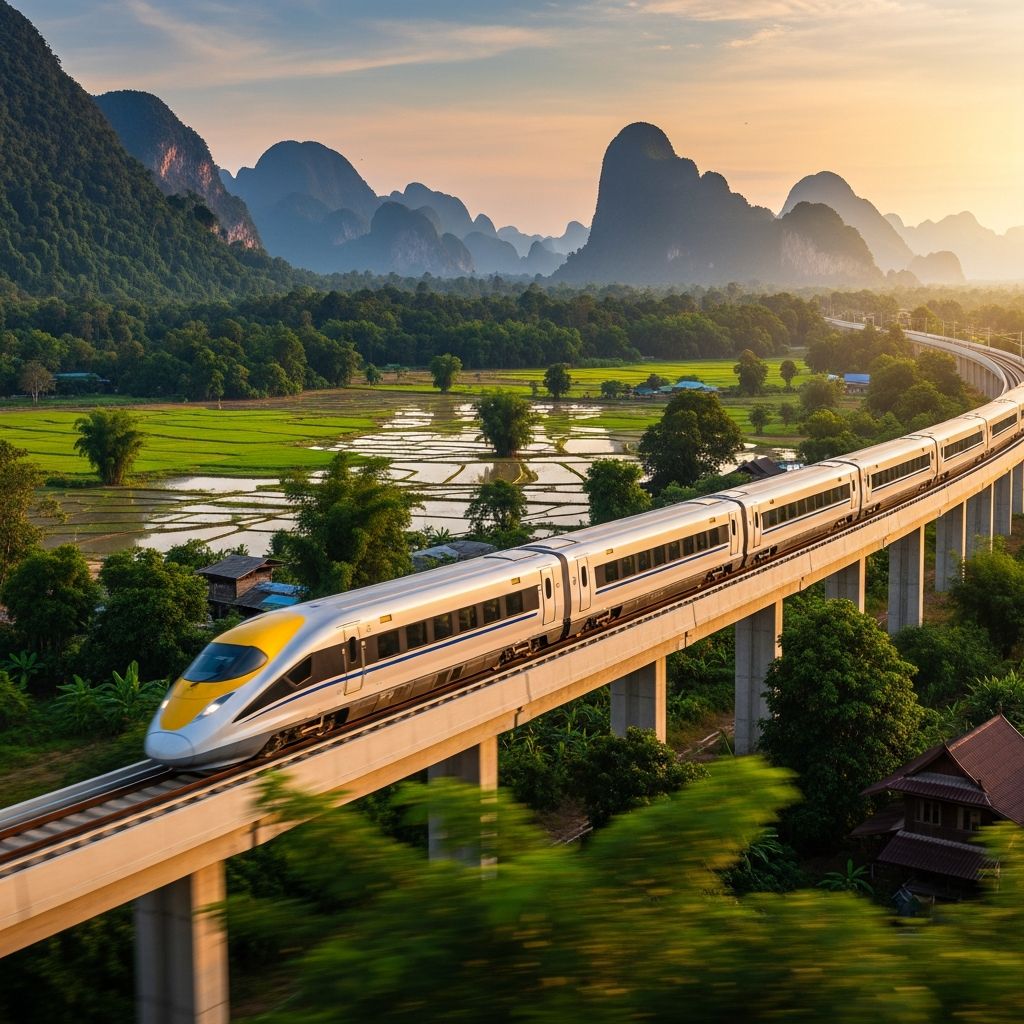
Thailand is on the cusp of a transportation transformation with its high-speed rail (HSR) network, designed to slash travel times between major cities and link the kingdom to international routes. The flagship Bangkok–Nong Khai line, capable of speeds up to 250 km/h, promises to make journeys faster, safer, and more efficient than road travel, addressing longstanding issues with traffic congestion and accidents.
Current State of High-Speed Rail Development
While Thailand lacks fully operational bullet trains today, significant progress marks the path forward. The first phase, connecting Bangkok to Nakhon Ratchasima, began construction in 2017 and stands at approximately 36% completion as of early 2025. This 250.77 km stretch includes 188.68 km of elevated track, 54.09 km at ground level, and 8 km of tunnels, ensuring smooth high-speed operations.
Government approvals continue to accelerate the project. In February 2025, the Thai Cabinet greenlit the second phase from Nakhon Ratchasima (Korat) to Nong Khai, set to start in 2025 and finish by 2030. Full operations across the Bangkok–Nong Khai corridor are targeted for the end of the decade, integrating with Laos’ rail system and China’s vast network via the Belt and Road Initiative.
Major Routes and Infrastructure Highlights
The core of Thailand’s HSR ambition is the Northeastern Corridor. Phase 1 spans from Krung Thep Aphiwat Central Terminal in Bangkok to Nakhon Ratchasima, featuring six stations and elevated designs to bypass urban congestion. Trains are planned to depart every 90 minutes from 6 am to 10 pm, covering the distance in just 1 hour and 30 minutes at a top speed of 250 km/h.
| Phase | Route | Distance | Est. Travel Time | Status |
|---|---|---|---|---|
| 1 | Bangkok to Nakhon Ratchasima | 250.77 km | 1.5 hours | 36% complete (2025) |
| 2 | Nakhon Ratchasima to Nong Khai | TBD | TBD | Approved 2025, start 2025 |
| 3 | Nong Khai to Vientiane (via Mekong bridge) | TBD | TBD | Planning |
Beyond this, visions include a two-tier structure at key hubs like Don Mueang Airport, with HSR on upper levels and local lines below. The network draws from 2010 parliamentary plans for five radiating lines from Bangkok, all at 250 km/h standards.
Integration with Regional and Global Networks
Thailand’s bullet trains form a vital link in ASEAN connectivity. At Nong Khai, the line will connect directly to Laos’ high-speed rail, operational since 2021, enabling seamless travel to Vientiane and onward to Kunming in China. This creates a Bangkok-to-China route without transfers, revolutionizing freight and passenger movement.
Trains matching those in Laos and China—capable of 350 km/h peaks but restricted here for infrastructure—will serve the lines. Prime Minister Paetongtarn Shinawatra has prioritized this alongside double-tracking existing rails and southern land bridge projects.
Comparing Speeds: Thailand’s Trains vs. Neighbors
Thailand’s upcoming 250 km/h bullet trains outpace current options. For context:
- Red Line electric trains in Bangkok reach 160 km/h unofficially (official max 145 km/h).
- Laos HSR: 160 km/h.
- Malaysia electrics: 150 km/h.
Existing Thai trains average far slower, making HSR a game-changer for long hauls like Bangkok to Chiang Mai or the northeast.
Economic and Tourism Impacts
High-speed rail promises economic booms. Faster connectivity will spur tourism in Nakhon Ratchasima’s ancient sites, Isan’s cultural heartlands, and border regions. Reduced road travel—Thailand’s notorious for high accident rates—enhances safety. Businesses gain from efficient logistics to China, boosting exports.
Stations will integrate multimodal hubs: airports, buses, and metros, easing Bangkok’s chaos. Projected service: 6 trains daily per direction, fostering day trips and regional hubs.
Challenges and Timeline Realities
Delays have plagued the project since 2010 proposals, impacted by the 2014 coup and funding shifts. Initial 2018-2019 targets slipped, but Thai funding—not Chinese—keeps control firm. Recent cabinet pushes aim for 2030 completion.
Environmental concerns around tunnels and reservoirs are managed via engineering feats like the Lam Takong tunnel. Public excitement builds, with commuters already testing Red Line speeds as a preview.
Planning Your Bullet Train Journey
When operational, expect modern amenities: spacious seats, Wi-Fi, dining, and business class. Book via SRT apps, with fares competitive to flights for mid-distances. From Bangkok, zip to Korat for Khao Yai National Park or Silk routes, then extend northeast.
- Bangkok to Nakhon Ratchasima: Explore Thao Suranari Monument, ancient Khmer ruins.
- To Nong Khai: Mekong views, Sala Kaew sculptures, Laos gateway.
- Beyond: Vientiane temples, Luang Prabang, Kunming highlands.
Frequently Asked Questions (FAQs)
When will Thailand’s bullet trains start running?
Phase 1 (Bangkok-Nakhon Ratchasima) targets late 2020s; full Bangkok-Nong Khai by 2030.
What is the top speed of Thailand’s HSR?
250 km/h operational maximum.
Will it connect to China?
Yes, via Nong Khai-Laos line to Kunming and China’s network.
How much will tickets cost?
Not finalized; expect affordability vs. flights/buses, around THB 1,000-2,000 for Phase 1.
Are there hotels near stations?
Stations designed as transport hubs with nearby accommodations; Nakhon Ratchasima offers resorts and city hotels.
Future Expansions and Broader Network
Beyond the northeast, plans radiate: south to Surat Thani, north to Chiang Mai, east to Cambodia. A unified operator may manage all, per 2013 visions. This HSR web positions Thailand as Southeast Asia’s rail leader.
In summary, Thailand’s bullet trains herald efficient, scenic travel, shrinking distances and opening horizons. Monitor SRT updates for bookings as phases launch.
References
- Bangkok–Nong Khai high-speed railway — Wikipedia. 2025-02-04. https://en.wikipedia.org/wiki/Bangkok%E2%80%93Nong_Khai_high-speed_railway
- High-speed rail in Thailand — Wikipedia. Accessed 2026. https://en.wikipedia.org/wiki/High-speed_rail_in_Thailand
- Thailand’s High Speed Trains can go 160 km/hour — Thai Train Guide. 2023-06-15. https://www.thaitrainguide.com/2023/06/15/thailands-high-speed-trains-can-go-160-km-hour/
- Thai High-Speed Rail Project Set For Completion in 2030 — The Diplomat. 2025-01. https://thediplomat.com/2025/01/thai-high-speed-rail-project-set-for-completion-in-2030-government-says/
- Thai–Chinese High-speed Railway (HSR) Develop Thai railways — State Railway of Thailand. Accessed 2026. https://www.highspeedrail-thai-china.com/en/
Similar Articles








Read full bio of medha deb